


The Society for Technical Communication, the Special Libraries Association, and other professional groups are shutting down or cutting deep, and AI is the easy explanation. The membership and revenue data tell a different story — one that started twenty years before ChatGPT and explains why some associations are dying while others are growing.
Is AI killing your professional association? It’s an easy question to ask right now.
The Society for Technical Communication (STC) lasted 72 years and had 25,000 members at its peak. On January 29, 2025, it announced its shutdown. Two months later, the Special Libraries Association followed. The Society of Professional Journalists cancelled its annual convention and named a $391,000 deficit. The Public Relations Society of America’s 2026 board chair told members plainly: “We are at a crossroads.”
If you work in tech, you probably heard about STC. If you work in journalism, publishing, library science, or communications, you may have watched something similar happen closer to home. If you’re in a field that hasn’t felt it yet … it may be coming.
The easy explanation is AI. And there’s something to it.
When staying current in your field means creating a prompt instead of attending a conference or reading a gated newsletter, the case for annual dues gets harder to make. But STC’s membership had been falling since 2002. That’s twenty years before ChatGPT. IRS filings show negative net assets every year from 2013 onward.
Whatever killed these organizations, it didn’t arrive in 2023.
I’ve been making a similar argument about higher education.
Assessment was already broken; AI just exposed it. Grades, assignments, and credentials built to gatekeep access to knowledge stopped making sense the moment that knowledge became freely available. Professional associations hit the same problem, just on a different timeline.
I’m researching this now by surveying practitioners across fields in technical communication about what professional community actually means to them, and what they do when the institution behind it disappears.
More on what I’m finding in the posts ahead.
The numbers tell a slow story
I’d actually been meaning to join STC for a few years.
Every time I got around to it, another no-dues community already had what I needed, so I never signed up. I wasn’t trying to make a point. I just never got around to it. It would seem a lot of technical communicators were making the same quiet choice.
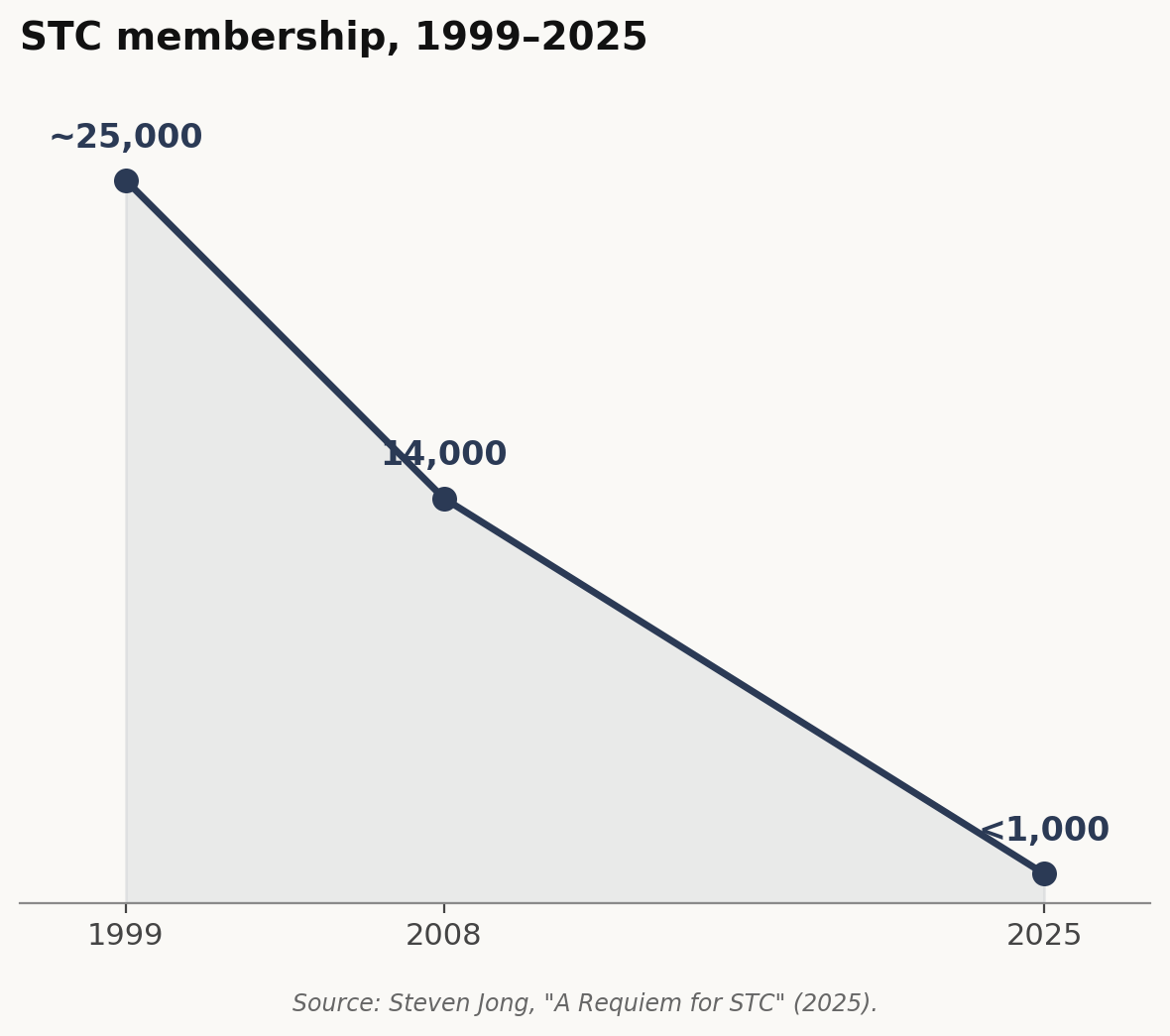
The Society for Technical Communication peaked at roughly 25,000 members in the late 1990s and spent the next two decades bleeding them out. A former board member who tracked the data himself estimates membership would have fallen below 1,000 by the time the doors closed. The organization stopped publicly reporting membership figures after 2007, which tells you something about what those figures looked like.
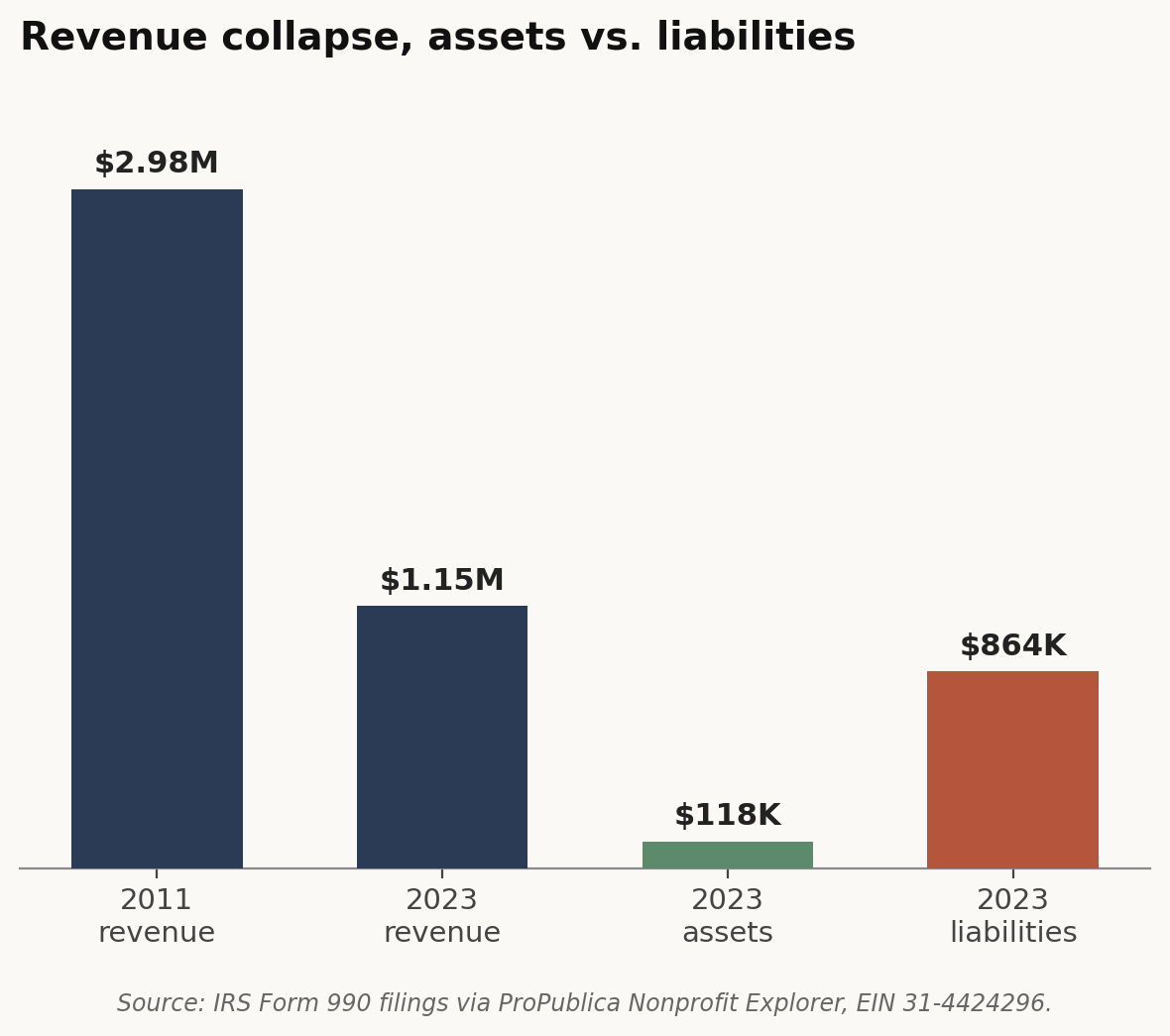
The finances follow the same arc: revenue fell by more than half between 2011 and 2023, and the organization carried negative net assets every year for the last decade of its existence. The chart below has the full numbers.
What STC was selling made sense when those things were genuinely scarce. You paid dues because that’s how you got the journal, attended the conference, and earned the certification that signaled your competence to employers.
The internet didn’t destroy that value overnight, but it spent twenty years making it cheaper and cheaper to get elsewhere.
Free forums, YouTube tutorials, LinkedIn groups, and eventually entire communities built around specific tools and workflows pulled the same audience STC needed to survive.
AI maybe accelerated the last leg of that erosion, but it didn’t start it.
It’s not just STC
Individual-membership nonprofits that peaked in the late 1990s, built their revenue around dues and an annual conference, and offered credentials and a journal as their core value proposition are under pressure across professional fields.
Some are collapsing. Some are cutting. A few are doing something different.
Two months after STC closed, the Special Libraries Association announced it couldn’t pay its bills either. It had 14,000 members at its peak, a journal, and an annual conference, just like STC. Its members voted to dissolve rather than declare bankruptcy, merging into a larger information-science body by early 2026.
The Society of Professional Journalists cancelled its 2024 national convention, its treasurer telling reporters the organization faced a projected $391,000 deficit. PRSA, the leading professional association for public relations, opened 2026 with its board chair telling members that “meaningful change must occur for us to thrive for another 79 years.”
Not every association is dying. ACES: The Society for Editing has been growing. The Editorial Freelancers Association is growing. Meanwhile, the Association for Talent Development reported $53 million in revenue last year.
What did they do differently?
What this means for your field
So is AI killing your professional association?
Probably not directly.
But it may be the thing that finally made the problem impossible to ignore. That’s the same way it made certain approaches to teaching and assessment impossible to ignore.
What that means for your field, your professional identity, and where community goes from here is what I’m trying to understand.
I’m currently surveying practitioners across fields in technical communication about what professional community means to them now, and what they’ve lost or found since their associations started struggling.
If any of this lands for you, I’d genuinely like to hear from you.
The survey takes about 5-10 minutes.
it's not the same area, but I've run an small regional academic society for about 7-8 years now and it has other regional entities in other parts of the country. They've seemed to be struggling financially and I've certainly seen others professional association suffering. From my vantage point is that many of those associations have focused on offering things (including conferences) that were based often more on how much they could get out of institutions with the assumptions that their members (or members worth paying attention to) are full time.
In the organization I lead, it's more like 1/3 are FT faculty, 1/3 are grad students and 1/3 are independent schoalrs and/or PT faculty...and the full membership isn't accessible nor have the conferences been.
When we went virtual for conferences during the pandemic, we also made for a more affordable model of access and every since, our membership has been 2-3 times what it was prior to the pandemic and we've been able to offer a virtual confernece that brings in a much stronger cross section of knoweldge...
all of which is long-winded but I think affirms your suspicions that it's not the AI causing the diminishing of membership...