


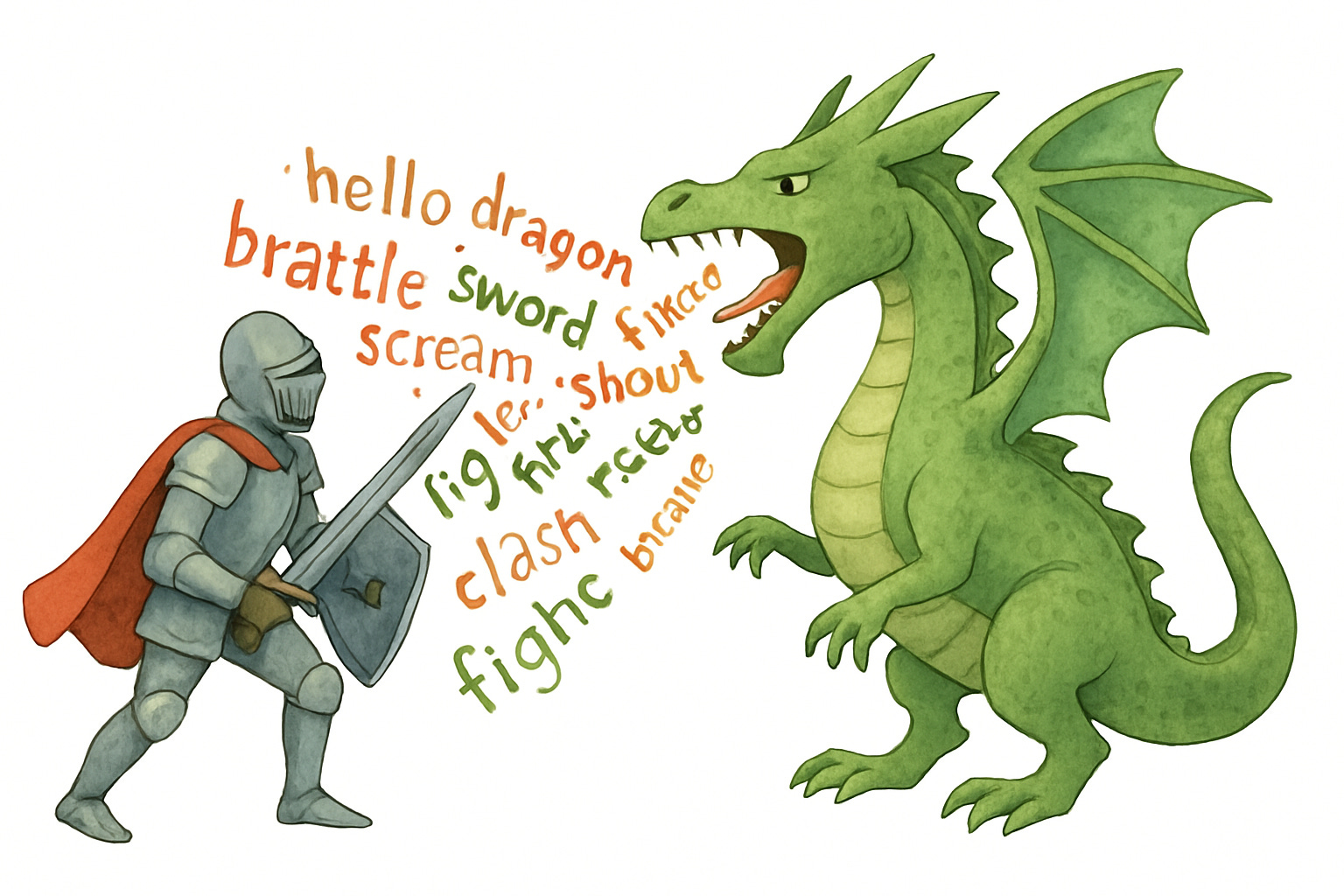
I’ve spent summers building Substack without a system, and it always breaks the same way: drafts accumulate, ideas scatter, deadlines slip when the semester hits. This year I built a visual map called The Churnivore, a project board for tracking status, and a Markdown archive to turn my scattered thinking into a legible, sustainable workflow where AI can actually participate.
This is the first summer in a long time when I am mostly free.
I’m not teaching.
I’m not buried in consulting.
I have research to work on, but I also have room to build things I’ve wanted for awhile:
a local AI knowledge base,
a personal RAG system,
and a better content workflow.
And, of course, time to write.
That last part is where things can really get overwhelming for me.
I have no shortage of ideas for Cyborgs Writing. Too many ideas has usually been the problem. My ADHD brain is good at generating possible posts, series, experiments, frameworks, and rabbit holes. It is less good at turning all of that motion into a publishing plan that survives more than a few weeks.
So I tend to go with the flow.
That works for a while. Sometimes it works better than planning, because I’m consistently engaged and discovering new thoughts and ideas. So I don’t necessarily want to flatten that out entirely.
But a Substack eventually becomes something you have to manage, especially when the busyness of a semester comes barreling into my writing habits.
Drafts accumulate.
Notes scatter.
Themes recur.
Arguments get halfway built and then left open.
Readers also have a reasonable expectation that you will show up again next week.
And somewhere in the distance, next next year’s dragon is already coming down the tracks.
The Map
So this summer I’m using the open space to do something I usually avoid. Build a content plan.
I don’t really like planning in the abstract or ticking boxes. Administrative rituals too often remind me I have failed to perform or that I’ve missed something (or how much I still have to do).
Any system that depends on my dutiful attention to tiny status updates will eventually break.
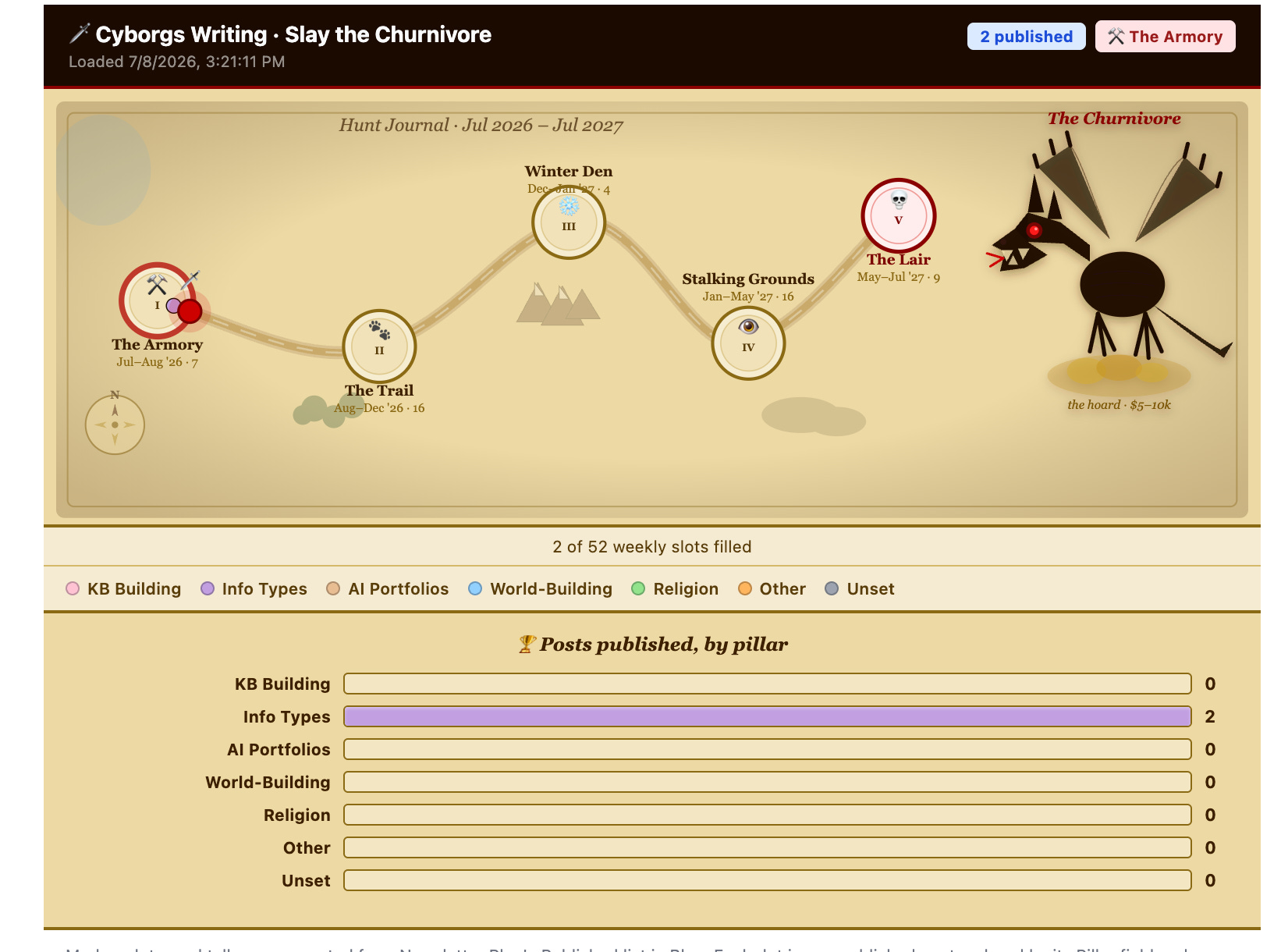
So I drew a monster.
The monster is called The Churnivore. It sits at the end of a winding path, guarding a pile of gold that represents a modest but meaningful goal of building Cyborgs Writing into a sustainable publication over the next year.
The path has five regions. Every week between now and next July is a milestone. Each published post moves me a little farther along the trail.
It looks a bit ridiculous, but hopefully that’s why it’ll work.
A content calendar tells me what is supposed to happen. The map tells me where today sits in a larger arc. It turns the year into a quest instead of a spreadsheet. I can see which themes are moving, which ones are neglected, and how much of the path is still ahead.
And, ultimately, I’m hoping it gets me ahead of schedule, instead of writing “just-in-time.”
The Workflow Behind the Map
But the map can’t carry the whole workflow, or else it becomes another project-management chore.
The actual workflow lives in a project board. I use Blue to track whether a post is an idea, in progress, scheduled, or published. A draft ready for human editing gets a card. A scheduled post moves forward. A published post gets its link added back to the system, then archived in my Markdown knowledge base.
The map follows this board (connected to Claude via an MCP).
I’ve also created a complete Markdown archive of all my writing, where the publish versions are stored with all the appropriate metadata like dates, related ideas, and reusable components.
Each part protects a different kind of work. Production belongs on the board. The year planning belongs on the map. The reusable thinking is in the knowledge base.
AI can participate in that system without being asked to invent the whole thing from scratch.
That has become one of my main lessons from working with AI over the past year. The model is rarely the only variable that matters. The structure around the model often matters more.
A post with a status, pillar, date, and link becomes readable to the system. A published piece with a predictable home can be archived. Ideas tied to the map are easier to retrieve than ideas scattered across half my digital life.
The AI is not making the system smart.
The system is making the work legible.
The Five Regions
The map has five regions, each representing a theme I’ll explore this year:
KB Building — Markdown knowledge bases, personal archives, and systems for making your own thinking retrievable.
Info Types — Structured prompting, information architecture, and designing content that AI can actually use.
AI Portfolios — How writers, students, and professionals can document and demonstrate their work with AI.
World-Building — Collaborative fiction, interactive storytelling, and AI as a creative partner.
Religion — Faith, meaning-making, and the deeper questions that emerge when machines start to think.
For now, I want to mark the shift.
I am not trying to publish more by sheer force of will.
I am trying to build a system that can hold more of the work than my attention can hold on its own.
The Churnivore is not really a monster outside the system. It is what happens when you don’t have a plan.
This year, I’m walking the path. The Churnivore is waiting. But for the first time, so is a map … that is, a structured plan.