


Oftentimes, people are surprised that I teach writing … and AI. Isn’t that some kind of contradiction?
I often get this question: “What’s left for writers when AI can generate adequate text?”
The question itself reveals a misunderstanding about what makes writers valuable.
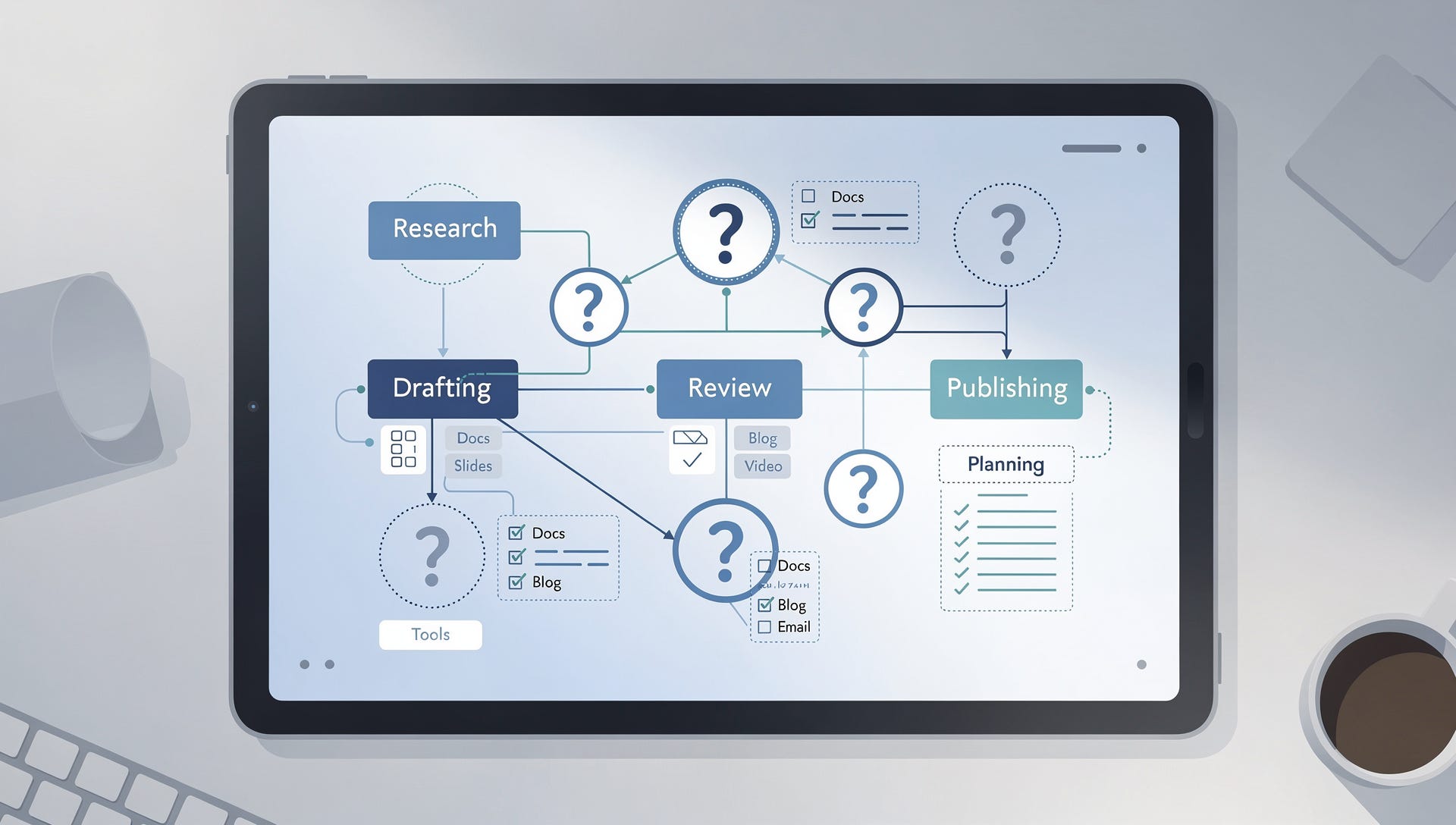
Last week I ran a workflow mapping exercise with twenty students from different disciplines—computer engineers, English majors, cybersecurity students, elementary education majors. I wanted them to map their actual writing workflows before we started integrating AI.
What happened revealed something important about the difference between describing a process and understanding a workflow.
The computer engineers struggled. They could explain their coding workflow in extraordinary detail. But their writing workflow?
“I just... do it until it’s done.”
The English majors did better initially. Brainstorming with clustering diagrams. Research with annotated bibliographies. Thesis development. Zero drafts for idea generation. Revision for argument structure.
In a world where AI supposedly makes writers obsolete, the ability to map operational workflows might be writers’ most valuable professional skill. Not just describing what you do, but understanding the entire system through which work flows.
But it became clear as we dug deeper that they were describing an idealized process or the intellectual steps they’d been taught. When I asked about the operational reality, they struggled too.
“I write in Google Docs, I guess?”
“My notes are... everywhere. Notebook, phone, scattered documents.”
“I don’t really have a system for organizing research.”
They could articulate the intellectual process. But the operational workflow remained largely invisible.
That distinction matters enormously for AI integration.
This pattern held across disciplines. Students from humanities backgrounds could articulate intellectual process, or the moves writers make.
Technical students could describe technical workflows, or the systems code moves through. But almost no one could clearly map their writing workflow, or the operational system through which their intellectual work actually happens.
In a world where AI supposedly makes writers obsolete, the ability to map operational workflows might be writers’ most valuable professional skill. Not just describing what you do, but understanding the entire system through which information flows.
This year I’m releasing beta access to my course, Writing with Machines, which helps writers and content professionals take a workflow approach to AI. Click below for more info.
The Irony of Technical Education
Those computer engineers already think in workflows for their technical work. They understand systems, information flow, version control, deployment pipelines, etc. They can map how code moves through their development environment.
But they haven’t applied that systems thinking to their intellectual work.
Meanwhile, English majors have been trained to articulate intellectual process, but typically in isolated academic contexts. They haven’t learned to map workflows in operational terms like tools, formats, handoffs, and information design.
Content professionals (or most professional writers) bridge both worlds. We understand intellectual process AND operational workflow.
We know that “writing” isn’t just thinking work. It’s information moving through systems.
Research lives in databases or note systems.
Drafts exist in specific tools with version histories.
Reviews happen through particular platforms.
Final outputs have required formats and distribution channels.
We already think in workflows because your work requires it.
When I research and collaborate with organizations like Motorola or Hitachi Energy on their content operations, the people who excel in operational roles typically come from content backgrounds. Not because they’re more creative (though they might be), but because they can see how information moves through a system and articulate what happens at each stage … in operational terms, not just intellectual ones.
That’s not a skill you automatically gain from learning to code or from studying literature. It’s a skill you develop from working in environments where content moves through systems and someone has to understand and improve those systems.
Why Workflow Mapping Matters Now
The ability to articulate intellectual process has always been valuable for writers. But AI integration requires workflow thinking … understanding the operational system, not just the thinking moves.
During the exercise, I asked students to identify friction points. Where do things slow down, where do you get stuck?
The English majors identified intellectual friction.
“I hate writing conclusions.”
“The transition from outline to draft feels like starting over.”
“Synthesizing research into coherent arguments is hard.”
The technical students identified task friction.
“Finding sources takes too long.”
“Bibliography formatting is tedious.”
“Blank page anxiety.”
But when I pushed them to think operationally, different patterns emerged.
One English major got specific about how she can write body paragraphs fine once she has her evidence organized. But she struggles with synthesizing everything into a conclusion that doesn’t just repeat what I already said.
This is process articulation. She knows the intellectual move that’s difficult (synthesis and elevation rather than summary). That’s valuable.
But then I asked: “Where are your body paragraphs when you’re trying to write the conclusion? What tool? What format? Can you see all your arguments at once, or are you scrolling?”
Long pause.
She then talked about how she writes each section separately, and by the time she gets to the conclusion, she’s forgotten what’s in the earlier sections … so she’s scrolling back and forth a lot.
Now we’re talking about workflow. The friction isn’t just intellectual. It’s operational. Information is organized in a way that makes synthesis difficult. The tool setup creates the problem as much as the intellectual challenge.
Compare that to “finding sources takes too long.” Also legitimate, but what’s the actual workflow friction? Is research scattered across multiple databases with different interfaces? Are you re-searching for things you’ve already found because notes aren’t organized? Is the problem identifying keywords, or is it that each source requires switching contexts and losing your train of thought?
Without mapping the actual workflow, AI integration becomes throwing technology at a vague sense of difficulty.
What AI Actually Needs From Writers
AI does one thing extraordinarily well: pattern-matching. It recognizes structures, suggests approaches, provides frameworks based on millions of examples.
But it can’t tell you which approach fits your specific situation unless you can map your actual workflow … not just the ideal process, but the operational reality.
The content professional who understands both the intellectual challenge (synthesis in conclusions) AND the workflow friction (information scattered across tools, requiring constant context-switching) can integrate AI strategically.
Maybe AI helps by consolidating key points from different sections. Maybe it suggests synthesis patterns. Maybe it’s not an AI solution at all. Maybe the workflow needs redesigning so information is visible when you need it.
The one who just says “help me write my conclusion” gets generic output because they haven’t mapped where the real friction lives.
This is why workflow mapping makes writers MORE valuable in AI environments, not less. Because effective AI integration requires:
Understanding how work actually flows through tools and systems
Identifying where in operational workflows AI can help (and where it can’t)
Distinguishing intellectual challenges from operational friction
Redesigning workflows when needed, not just automating bad processes
Making both intellectual work and operational systems visible for improvement
These are content operations skills. The kind of thinking you develop from working in environments where content moves through systems and someone has to understand, document, and improve those systems.
The organizations that integrate AI effectively have people who can bridge technical capability with operational thinking. They need people who can build the systems AND people who can articulate the workflows those systems support.
The engineers in my class will build better chatbots than the English majors in a functional sense. No question. But content professionals already understand how to map the operational reality of knowledge work, not just describe the idealized process. Both are needed.
The Mixed Group Revelation
By the end of class, the groups that produced the richest insights probably won’t be the homogeneous ones. They will be the mixed groups where an English major, an engineer, and an education major talked through their processes.
The English major can learn that version control isn’t just for code. It’s a strategy for managing drafts. The engineer can discover that concept mapping could organize technical documentation. The education major can realize her strategies for making content accessible to children were universal design principles.
They can teach each other to see their own processes differently.
This mirrors what I see in successful content operations teams. The organizations that integrate AI effectively have people who can bridge technical capability with operational thinking. They need people who can build the systems AND people who can articulate the workflows those systems support.
Content professionals bring that operational thinking. Writers understand modularity, that writing happens in chunks (research phase, outline phase, drafting phase) and that AI works best with chunked information and targeted requests. You know the difference between extending capability at a specific friction point versus replacing judgment in complex synthesis.
You already think in workflows. You just might not have recognized it as a marketable skill.
What This Means for Your Work
The panic narrative says AI replaces writers because it can generate text. But text generation was never the whole job.
The actual job includes:
Diagnosing what needs to be communicated and why
Mapping how information flows through operational systems
Identifying where automation helps versus where human judgment is essential
Designing workflows that support quality at scale
Maintaining meaning and accuracy across complex operations
These are content operations skills. Operational thinking applied to knowledge work. Workflow mapping, not just process description.
When organizations implement AI successfully, it’s because someone can map the operational workflows clearly enough to know where AI fits. When implementations fail, it’s usually because they’re throwing AI at undefined processes or, worse, automating workflows that were already broken.
The computer engineers in my class will learn to map their writing workflows this semester. But they’re starting from further back than content professionals and writers who already understand that content moves through systems.
We need to recognize that workflow mapping as the strategic skill that makes you valuable in AI environments.
What’s Next
I’m teaching this class all semester as a laboratory for systematic AI integration. The students are building an AI tool for disaster communication, which is high-stakes work where accuracy matters and hallucinations aren’t acceptable.
I’ll be sharing my thoughts as we move through the semester.
Next week I want to talk about the difference between AI pattern-matching and human reasoning. This is key to understanding AI workflows.
But you can’t integrate AI effectively into workflows you haven’t mapped.
If you want to move beyond casual AI use to systematic integration, I’m opening beta access to my Writing with Machines course for paid subscribers. It’s built around this exact challenge: mapping your actual workflows and integrating AI strategically at specific friction points.
The beta runs through this semester, giving you the complete framework while I refine it based on real-world feedback.
Learn more about the beta course → (paid subscribers only)
P.S. Want to test this for yourself? Try mapping your own workflow for a typical content project. If you can articulate not just what you do but why you do it at each stage, you’re already ahead of most people trying to integrate AI. If you find it harder than expected—you’re in good company, and it’s worth figuring out.