


I’m giving a webinar this month for a group of graduate researchers who want to use AI without letting it write their work for them.
This became the perfect use case to dig deeper into using information types when researching and writing with AI.
Before AI can help you think, you have to organize what you know.
Here’s the short version of the webinar, in case it’s useful framing. It might be worth a longer post later after the webinar, but its a preview of whats to come.
I’m currently working on structured approaches for managing personal knowledge using markdown files and agentic AI. Stay tuned … coming soon!
Before AI can help you think, you have to organize what you know.
Most AI training starts with tools. Which app? Which prompt?
The real place to start is the structure of what you feed it.
If you sort your reading notes by the job each piece does (or the questions they answer), then you get notes you can find, build on, and write from. The fact that AI also performs far better on top of those notes is a bonus.
Now the method itself.
What happens to everything you read
Here how research notes often go … at least for me, and probably a lot of graduate students.
You read an article, highlight what looks important, and drop a few quotes into a document.
Maybe you use a separate notes app to help you organize … maybe not. Either way, the pile grows.
Months later you’re searching the same PDFs again or an idea you remember seeing but not sure where. But the highlight or cut and paste never told you what job the note was doing, and the connections you noticed while reading have gone cold.
It used to be the only risk to disorganization was either frustration or more time looking for things then actually drafting.
But that’s not the only risk anymore.
If you give your AI model unstructured notes, the model supplies its own structure for … and that is where a lot of our thinking happens.
➡️ Check what I mean by this in my latest deep reading post.
Unsorted highlights don’t produce messy output. They produce confident output shaped by the model’s training (or what it happens to find on its own), not your thinking.
You’ve just given up you thinking and voice to AI, maybe without even knowing, because most people do not watch how AI models “think” (or when it prompts itself to go deeper into a question or task).
So the question isn’t whether your notes have a structure. It’s whose. Yours, or the machine’s.
Five jobs for organizing notes
When you read almost any research article, nearly everything in it is doing one of five jobs.
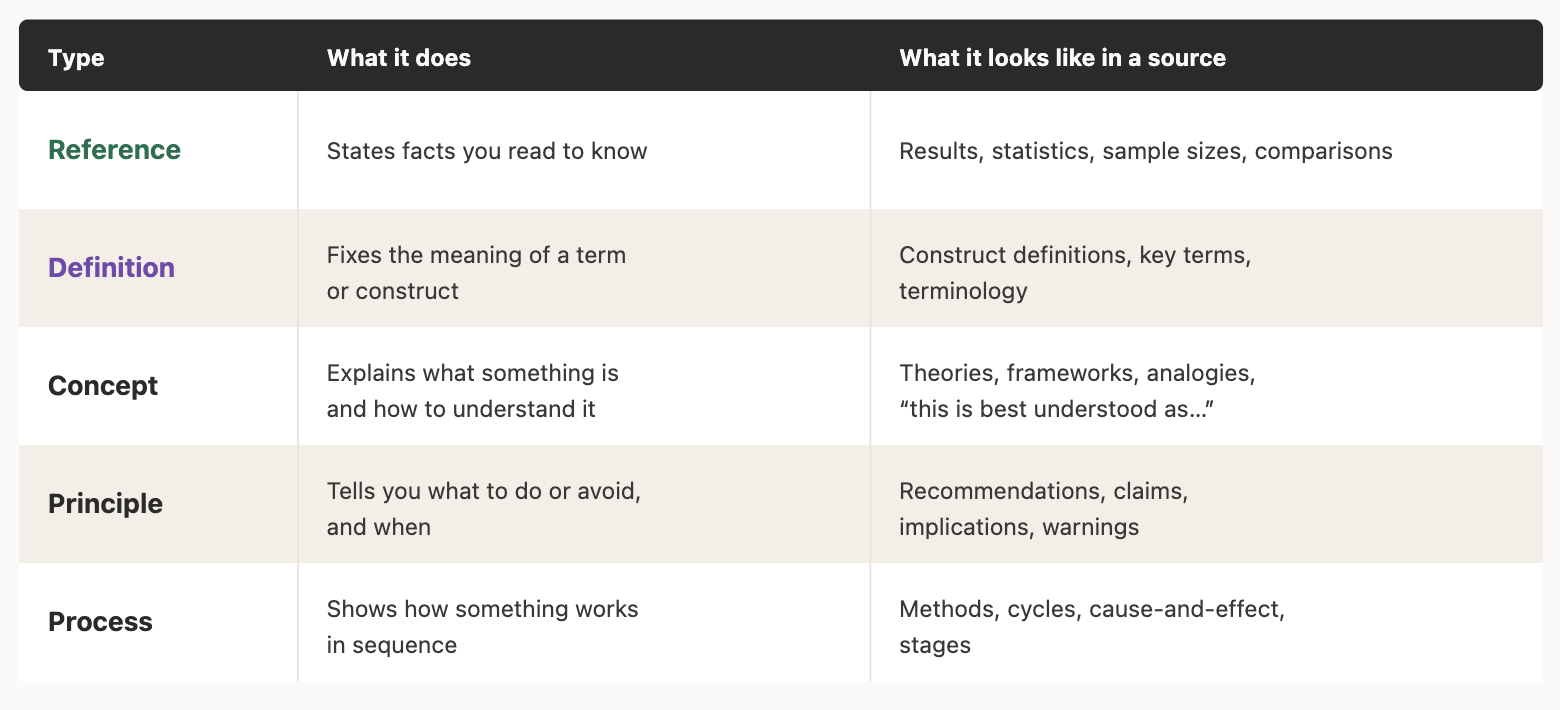
These types come from a sixty-year-old idea. In 1969, Robert Horn argued that content has a structure independent of its topic.
How you organize a piece of information depends not on what it’s about, but on the job it does for a reader.
➡️ This has become the centerpiece for how I design context for AI systems. Check out more here.
His method, Information Mapping, ran through technical writing and instructional design for decades. What was once a discipline for writers turns out to be exactly what makes knowledge legible to a model.
Sort your notes by the job, not the format. A bulleted list in an article might be three definitions, three recommendations, or the stages of a method.
Look at what the reader is meant to do with it.
Read first, sort second
The practice is four moves.
Read the full source once, marking anything you’ll want again. Don’t categorize yet. Focus on understanding the source.
Go back through your marks and ask of each one: reference, definition, concept, principle, or process?
Rewrite it in your own words under that heading. Rewriting is where the understanding happens, and it keeps the notes sounding like you.
Add a short reaction where you have one, for example, agreement, doubt, a connection to your own work. Mark it clearly as yours. These are the seeds of original writing.
Then you provide the context and purpose on the top of the note (or whats often called meta-data in the content world).
The five types capture what a source says. They don’t capture what it is:
who wrote it,
what it argues overall,
and why you’re reading it.
Keep that in a short block at the top: source, argument, why you’re reading it, a tag or two.
On paper it reminds future-you what you’re looking at. In a knowledge base, those same lines become the metadata an AI reads first.
What one paper looks like sorted
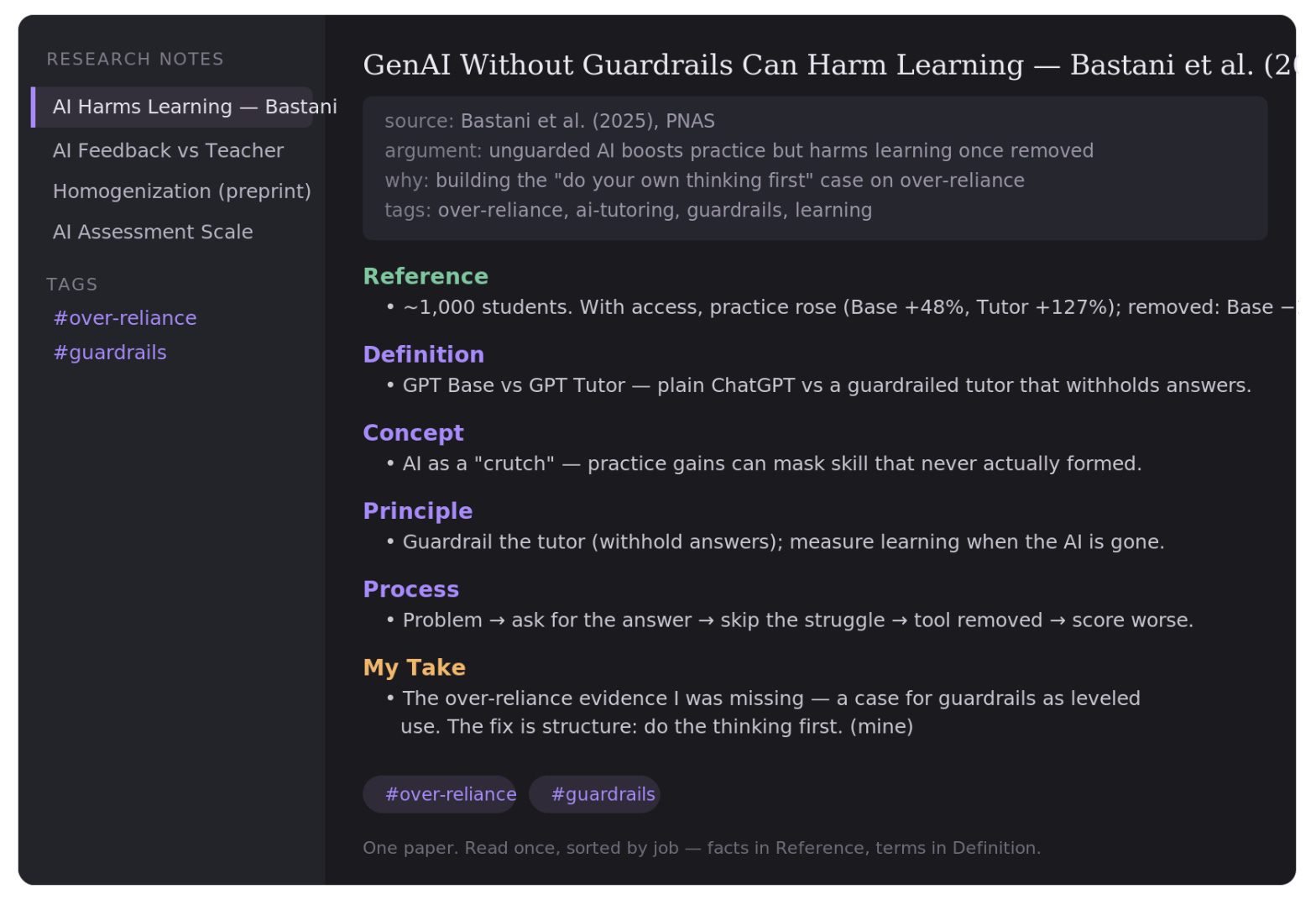
Say you’re reading one of the studies behind the AI-in-education debate, for example Bastani and colleagues’ 2025 experiment, which found that an AI tutor without guardrails raised students’ practice scores but left them worse off once the tool was taken away.
The resulting note might look like this:
➡️ You can see a real example that I created in Obsidian here.
When you later want what the research recommends, you go straight to your principles.
When you need the numbers, they’re in your reference.
When you need how the experiment actually ran, it’s in your processes.
Read three more papers this way and their principles line up beside these, so the agreements and contradictions become visible, which is where original synthesis starts.
Notice the paper is about what happens when you let AI do the thinking for you. The work looks better in the moment, then the skill isn’t there when the tool is gone.
Sorting the paper into types is the opposite move. You do the thinking first, in your own categories, so there’s nothing for a tool to stand in for later.
The understanding happens in the sorting, not the highlighting … or even the writing in some cases.
Why this is worth the extra minute
Structured reading is slower at first, but faster later. You retrieve quickly because you know what kind of thing you’re looking for, and you build quickly because a new source’s notes slot in next to the old notes in more relevant ways.
The structure ends up a record of your thinking about the sources rather than a just a random record of them.
Do the work and the model will reflect that work. Leave it undone and it has only its own random guesses.
When you finally bring AI in to draft a literature review, surface tensions across sources, or turn reading into teaching material, you need far fewer tricks than people claim.
If you have structured, well-thought through notes, you don’t need much of a prompt.
For paid subscribers: Below I provide a structured skill that has AI develop a synthesis based on information-typed research notes that you can try in any agentic tool or Claude Cowork.
